A nuclear robot can reach a place too dangerous for a person, but that is only the first test. The harder job is sending back useful data, handling a tool, and returning safely when the signal or motor fails.
This matters to plant operators, cleanup teams, and robotics engineers choosing systems for work near radioactive material.
The winning design won't be the one with the most dramatic video. It will be the one that keeps working after dust, heat, radiation, and poor visibility have taken their share.
- Reach comes first: A robot must enter spaces that block a person or make repeated visits unsafe.
- Data must stay useful: Cameras, radiation sensors, and force feedback need to support a real task.
- Recovery decides the job: Operators need a clear way to retrieve or repair the robot after a fault.
Where nuclear robots earn their place
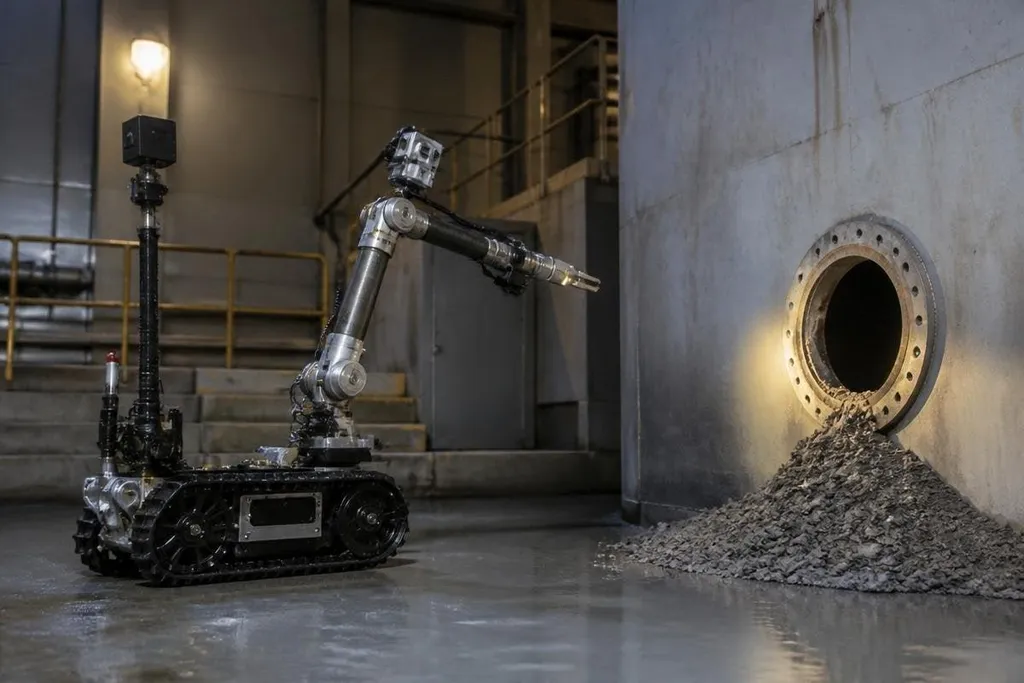
Nuclear work covers inspection, maintenance, emergency response, and plant shutdowns. Each task changes the robot design. A tracked vehicle may cross rough concrete, an articulated arm may handle a valve, and a small crawler may inspect a pipe or narrow passage.
Remote handling also protects workers from exposure. The robot carries cameras and sensors into the work area, then sends video and readings to an operator outside it. That operator may control the robot directly through teleoperation, or give it limited movement commands when the radio link is weak.
The useful measure is the task completed. “The robot entered the room” says little if its camera cannot see through dust, its arm cannot reach the valve, or its battery runs out before the inspection ends.
Radiation changes the hardware
Radiation can damage electronic parts over time. The effect depends on the dose, the type of radiation, the shielding, and the time spent in the area. A design built for a short inspection may need different hardware from one left near a reactor for repeated work.
Designers can place sensitive electronics behind shielding, keep control hardware outside the hot area, or use parts rated for radiation exposure. None of these choices removes the problem. Shielding adds weight, cables can limit movement, and remote electronics can make the robot harder to repair.
Heat and contamination add more limits. Seals must keep dust or liquid away from motors and gearboxes. The design may also need a surface that can be washed, isolated, or disposed of after a task. The cleanup plan belongs in the robot design from the start.
Autonomy helps, but recovery matters more
Radio links can weaken behind thick walls and metal structures. Systems that depend on a perfect connection may stop in the worst place. Local obstacle sensing and a stored route can help the robot return, but autonomy must be tested against the exact layout and hazards of the site.
That is why operators still matter. A person can notice a loose cable, choose a safer approach, or stop an arm before it damages a fragile part. The machine can handle repeated movement; the operator supplies judgment when the scene differs from the plan.
A nuclear robot’s value depends on the conditions behind its result: the site, task, test date, radiation level, and measured outcome. Robot24.com gives you a place to start that check before the next section sets out the questions buyers should ask.
What buyers should ask for
A product sheet rarely answers the questions that decide a nuclear job. Ask the maker for records tied to the task, the site, and the operating conditions.
- Radiation limit: What dose can the robot take, and which part fails first?
- Recovery plan: How will the team retrieve it after a motor, cable, or radio fault?
- Useful runtime: How long can it inspect or handle tools before a battery change?
- Cleaning method: Can the robot be decontaminated, or does it become waste?
- Operator workload: How many people control it, and how much training do they need?
- Proof from work: Has the same design completed the target task outside a staged test?
I’d judge a nuclear robot by its recovery plan before its autonomous features. A system that completes a slow inspection and comes home is worth more than one that moves quickly until its link drops.
The next useful proof will come from repeat work in real facilities: the same robot, the same task, and a record of failures, repairs, dose, and time on site. Until those records are public, the race remains a contest of prototypes rather than a settled industrial market.